
Llanito: what you hear across the frontier, and why
The first time I heard Llanito I thought I had stopped paying attention: a sentence started in English, finished in Spanish, and the two people talking did not seem to notice the join.
That was on one of my first trips into Gibraltar, soon after I moved to La Línea in 2021. If you live on this side of the frontier you will hear it too, in the frontier queue and from colleagues if you work over there. Here is what it is, whether it follows rules, and why the people who grew up speaking it are worried.
On this page:
What Llanito is ·
What it sounds like when you are new ·
Are there rules? ·
Is it disappearing? ·
If you are learning Spanish here ·
Sources
The short version
- Llanito is the way Gibraltarians move between English and Spanish, often inside a single sentence.
- Linguists who have studied it find regular patterns in where the switches fall. It is not random.
- Researchers disagree on how healthy it is. One recent study describes a drift towards English among the young, another still finds young people switching.
- The Government of Gibraltar presented Llanito at a language conference in Brussels on 22 September 2026, and runs initiatives to preserve it.
What Llanito is
Llanito is usually described as code-switching, which is the linguists’ term for moving between two languages in the same conversation. A 2024 study from the University of Valladolid defines it exactly that way, as switching between English and Spanish in Gibraltar. People who speak both languages use both, and the join is part of how they talk.
What it sounds like when you are new
If you are not a native speaker of either language, and you are not paying close attention, you lose the thread. You catch the English half, the Spanish half goes past, and by the time you have translated it they have switched back. I found it funny at first, and I mean funny the way something is interesting, not the way you laugh at someone. It is a very particular way of talking and nobody outside this corner of the world does it quite like this.
I cannot give you one phrase that stayed with me. What stays is the rhythm of it: for them it is completely normal to change language in the middle of a conversation, and after a while you stop hearing the change and start hearing the conversation.
Are there rules?
I did not know, and it turns out that people have studied it. A 2017 linguistics paper on Gibraltar found “regular and recurrent bilingual patterns”: the small words that organise speech, and modal expressions, switch often and show regularities. The Valladolid study found that age matters, and formality to a lesser degree. Younger speakers prefer tag-switches, which is dropping a short word or phrase from the other language onto the end of a sentence, while English tends to carry the sentence in some kinds of switch.
So there is a system under it. Nobody sat down and wrote it, and the speakers do not think about it, which is exactly how grammar works in every language.
Is it disappearing?
The older Llanitos I have heard talk about it are a little sad, because they feel the language is going. As far as I can hear, most young people in Gibraltar speak English, and my impression is that the real Llanito, the one their grandparents spoke, is dying.
The research does not settle it. A 2025 academic article describes Gibraltar as an unstable bilingual society moving towards English only, and says English is the dominant language of the youngest group. The 2024 Valladolid study still found young people code-switching, just in a lighter way, with those short tags rather than whole Spanish clauses. I think both can be true at once: the switching survives, and the Spanish inside it gets thinner.
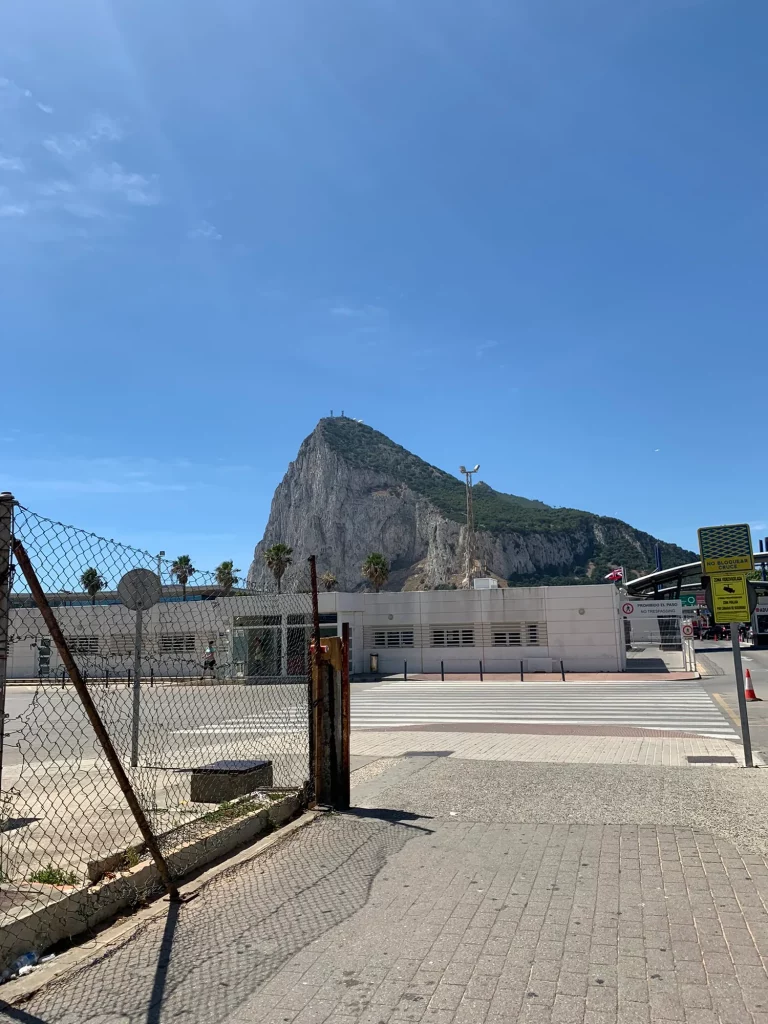
History explains part of it. Spain closed the frontier on 8 June 1969. It reopened for pedestrians, on a restricted basis, on 15 December 1982, and fully on 5 February 1985. For thirteen years the gates were shut and daily contact with Spain was cut. Since 1985 crossing has become normal again, and with the frontier checks gone this year it is easier than it has ever been. I see Gibraltarians practising their Spanish now, which may help the Spanish half survive, but it is not the same thing as growing up in Llanito.
Gibraltar is not ignoring it. In February 2026 Gibraltar Cultural Services and the Ministry of Culture asked for community projects to “celebrate, promote and preserve” Llanito. On 22 September 2026 Llanito was presented at an annual language conference in Brussels, its second appearance there, in a talk that compared its evolution with efforts to regenerate minority languages. I think they are right to try. There is nothing else like it.
If you are learning Spanish here
It feels a little familiar to me, and I suspect it will to you. I speak Romanian with my family and English at work, and at home we speak Spanish because I am learning it. Without meaning to, I drop Spanish words into English sentences all the time. That is my own Llanito, a newcomer’s version of it, for a different reason.
Andalusian Spanish is its own challenge. You can learn to ask for something in a shop and still not understand the answer, because people here speak fast. The fix is the street, not the app: talk to people, and when someone is going at four words a second, say despacito and ask them to slow down. Most will, with a smile.
Then one day a Gibraltarian colleague switches halfway through a sentence and you follow both halves without noticing. That is usually the day you realise you live here.
Sources
- HM Government of Gibraltar, press release 702/2026, “Llanito discussed in Brussels conference”, 24 September 2026.
- HM Government of Gibraltar, “Celebrating Llanito: a call for creative community initiatives”, 13 February 2026.
- HM Government of Gibraltar, “40 Years of the Opening of the Border 1985 – 2025”, 5 February 2025; and the Government Statistics Office Tourist Survey Report 2000 (frontier dates).
- University of Valladolid, study of code-switching in Llanito, 2024.
- Russian Journal of Linguistics, article on bilingualism in Gibraltar, 2025.
- John Benjamins, chapter on recurrent bilingual patterns in Gibraltar, 2017.